How a national delivery network and a single regulated standard are taking AI qualifications from Colombo to rural Sri Lanka.
Access is the real AI skills gap
Most conversations about AI education focus on quality: what should be taught, by whom, to what standard. Those questions matter. But in most countries, the harder problem is reach. A well-designed qualification does little for a learner three hours from the nearest city campus.
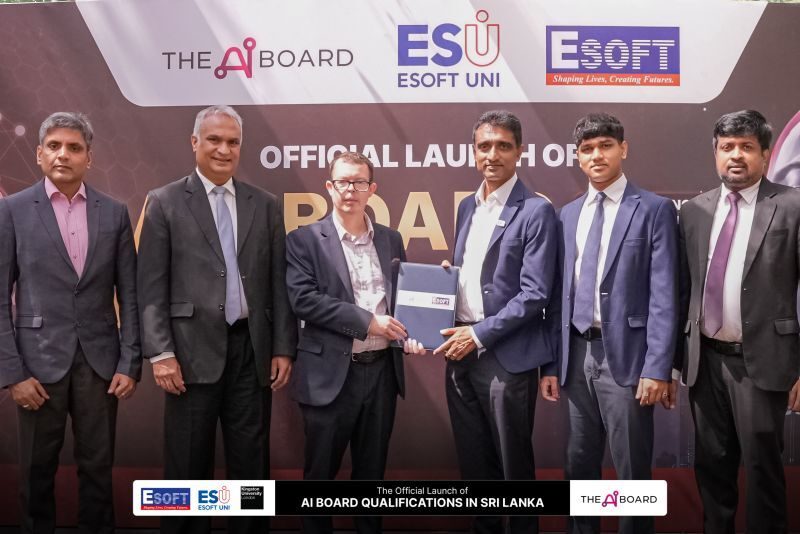
That is why the partnership between ESOFT Metro Campus and The AI Board, launched in Sri Lanka in September 2026, is worth looking at closely. It pairs a UK standard with a delivery network built for reach.
The partnership
ESOFT now delivers The AI Board's Ofqual-regulated AI qualifications across Sri Lanka. The partnership was launched on 28 September 2026 at Waters Edge, Battaramulla, with a panel on AI-powered governance and economic development featuring our Managing Director, Joseph Jones.
The numbers explain why this matters:
- 40 study centres across the island, from Colombo to rural towns and villages
- Hybrid and online delivery through ESOFT Online, for learners nowhere near a centre
- More than 25 years of ESOFT experience in Sri Lankan education, since 2000
ESOFT delivers the teaching and learner support. The AI Board, as the awarding body, sets the standard and quality-assures the assessment. Every learner on the pathway earns the same Ofqual-regulated qualification, wherever they study.
ESOFT's perspective
For Dayan Rajapakse, Founder, Chairman and Group Managing Director of the ESOFT Group of Companies, the case starts with how far AI now reaches into working life:
"AI is becoming part of almost every profession, so it is important that more people have the ability to understand, apply, and use it responsibly."
His emphasis is on breadth. The pathway is built for learners at every stage: those starting at school, those moving into higher education, and working professionals applying AI in their careers. ESOFT's commitment is to make it reachable both online and across its centres.
One pathway, from age 14 to master's level
This pathway is ESOFT's own way of embedding The AI Board's qualifications, built around its existing programmes and progression routes. Other centres can build their own route in a similar way, shaped to their learners and provision.
Beginner (age 14 and over): Level 2 Award in Understanding AI. Learners build a basic understanding of what AI is and how it works.
Foundation (Ordinary Level entry): Level 3 Diploma in IT, completed together with the Level 3 Award in AI: Concepts, Ethics and Applications.
This stage shows one of the most practical features of the model. The AI qualification runs alongside ESOFT's existing diploma, so learners add AI capability to a programme they are already taking. Other centres can embed The AI Board's qualifications in the same way, alongside existing diplomas, degrees or professional programmes, to strengthen those programmes and broaden their scope for learners. They can also be delivered as standalone courses, or as part of a full progression pathway like ESOFT's.
After the foundation stage, learners choose an AI Business or an Applied AI and Engineering track, which runs through Level 4 and Level 5 to top-up degrees from Kingston University London and master's programmes through ESOFT UNI.
The AI Business track matters as much as the engineering one. AI is no longer a skill only technical people need. The finance manager, the human resources lead and the compliance officer all need to understand what AI can do, where it fails, and how to govern it.
That is why The AI Board offers AI qualifications built for learners from non-technical backgrounds. Making AI capability accessible beyond technical roles is central to what we support and promote.
What this model shows
The ESOFT partnership is a working answer to a question many ministries and education groups are asking: how do you scale regulated AI skills nationally without diluting the standard?
The answer here has two parts: a single regulated standard, set by an awarding body focused exclusively on AI and data, and a delivery partner with genuine national reach.
If you lead an education group, a college network or a national skills programme and want to bring this model to your market, find out how to become an approved centre.